

China-Cyprus Martial Arts Exchange: Building a Bridge Through Every Movement
China-Cyprus Martial Arts Exchange: Building a Bridge Through Every Movement
On August 28, 2025, the Martial Arts Exchange Association of Chinese & Cypriots Friendship Promotion Association was officially established, and it is more than one year till now. President Zhou Tsz Shan Sam (Jeffrey) says the original intention was simple: to make Chinese martial arts a visible and tangible bridge between China and Cyprus. Over the past year, the Association has used martial arts as a bridge, making steady, steadfast strides in China-Cyprus cultural exchange.
01 From an Idea to an Association
Civil exchanges between China and Cyprus have become increasingly frequent in recent years, but getting ordinary people to truly connect with each other's culture requires more than signing agreements and hosting events. Moreover, it calls for a tangible vehicle.
Martial arts is exactly that vehicle.
The Association's mission is right there in its name: deepening cultural exchange between China and Cyprus, and promoting Chinese martial arts overseas. Its members come from China, Cyprus, the United Kingdom and other countries (international students, martial arts enthusiasts, ordinary citizens), from all walks of life but one thing in common: a curiosity about martial arts.
Under the leadership of President Zhou, the Association holds to a simple belief: martial arts should not be confined to competitive arenas; it should be a part of everyday life for ordinary people.
"Not everyone needs to compete, but everyone can make their body healthier and their mind calmer through martial arts."
02 The Spirit of Chinese Martial Arts in Every Movement
The Association's teaching centers on Long Fist and Tai Chi. One is powerful, the other gentle; seemingly worlds apart, yet in the Chinese martial arts system they point to the same goal: the unity of body and mind.
Long Fist features expansive, flowing movements that embody the idea of "moving like waves". Fast-paced and wide-ranging, it suits young people looking to channel their energy. Tai Chi, by contrast, is slow and emphasizes "using intention rather than force", requiring practitioners to focus their awareness on every joint in the body.
Take "White Crane Spreads Its Wings", the most classic Tai Chi movements, as an example. The movement mimics the instant a white crane opens its wings: one hand rises upward while the other presses down, the body turning slightly to the side. It looks like an elegant pose, but practitioners know: as the arms rise, the center of gravity must stay rooted in the feet; as the body turns, the rotation of the spine drives the entire movement.
Within a single movement lies the philosophy of "yin and yang giving rise to each other": up and down, left and right, hardness and softness, all coexisting in one posture.
Then there are "Commencing Form" and "Closing Form". Commencing Form is the opening sequence of Tai Chi: the hands slowly rise and fall, symbolizing the birth of all things. Closing Form returns to stillness, embodying the idea of a complete cycle, a return to calm. Hundreds of millions of Tai Chi practitioners around the world, regardless of country, share the same Commencing Form and Closing Form.
These movements need no translation. When Jeffrey demonstrates "White Crane Spreads Its Wings", onlookers can grasp the gist after a single glance: where the hands go, where the feet stand, how the body turns.
Language barriers? No problem. The language of the body is universal.
03 Communication Beyond Words
This is precisely what makes cross-cultural communication so powerful.
Chinese martial arts have been spreading overseas for over a century. Tai Chi has reached more than 180 countries and regions, with hundreds of millions of practitioners worldwide. In 2020, it was inscribed on the UNESCO Representative List of the Intangible Cultural Heritage of Humanity. In March 2026, the world welcomed the first "International Taijiquan Day". From Chenjiagou to Nicosia, from Beijing to Limassol, the entire world shares the same "Commencing Form"
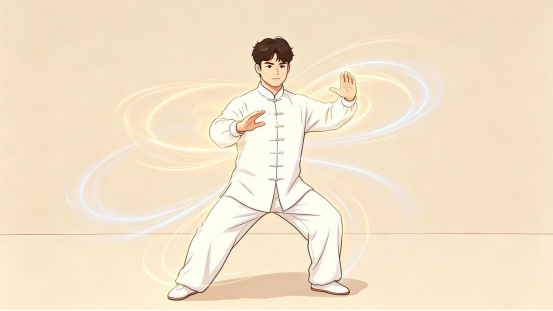
Screenshots of the martial arts and Tai Chi tutorial produced by the Association
The Association offers martial arts classes to the public. Participants need no prior experience, nor do they need to speak Chinese. Long Fist, Tai Chi, from commencing form to closing form, they simply follow along, movement by movement.
This language-free form of exchange opens another possibility: when language and cultural background become barriers, the body becomes the most direct medium of communication.
In May 2026, the Association hosted a martial arts exchange event for Chinese and international students at Wuhan College of Communication. International students from France, Canada, Hungary and other countries learned Long Fist from their coaches. There was no simultaneous interpretation on site, but the movements were the translation. Szabo Dorottya, an international student from Hungary, said martial arts had "opened up another layer" of her understanding of Chinese culture.
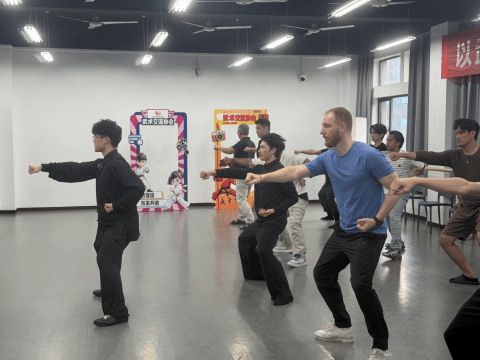
Young people from China and abroad practicing Long Fist together
04 Strengthening the Body, Cultivating the Mind
The essence of martial arts lies in "stopping weapons": the character 武 combines 止 (stop) and 戈 (weapon).The true martial prowess lies not in aggression, but in preventing conflict and safeguarding peace. This wisdom comes from King Zhuang of Chu in the Zuo Zhuan, and after more than two thousand years, it has not lost its relevance.
"The unity of Heaven and humanity" represents an even deeper pursuit. In its later stages, martial arts training seeks harmony between the rhythm of individual life and the rhythms of nature: Tai Chi's principles of "overcoming hardness with softness" and "deflecting a thousand pounds with four ounces" are the physical embodiment of this philosophy.
For ordinary participants in Cyprus, this philosophy may seem abstract. But the benefits for physical fitness are very real. Tai Chi's gentle, slow movements are suitable for people of all ages. Regular practice can improve coordination, strengthen cardiovascular and respiratory function, and it can also relieve stress. Some overseas practitioners call Tai Chi "a good medicine".
There is no need to learn complex forms. Even just following along with a few simple movements —stretching the body, regulating the breath — captures the simplest, most down-to-earth value of martial arts.
The Association does not pursue competitive performance. It simply hopes that with each session, participants become healthier in body and more at ease in mind.
05 From Martial Arts to Understanding China
A person may start practicing Tai Chi simply to stay fit. But as training continues, questions arise: "Why is this movement called White Crane Spreads Its Wings"? They begin to wonder about the origins of Tai Chi, to ask what yin and yang mean, and even to feel curious about the cultural soil from which this martial art grew.
This is the significance of martial arts as a "bridge": not to make others understand China all at once, but to draw them in first through a single, concrete movement, and then let them follow that movement step by step, drawing closer.
China and Cyprus signed an inter-governmental cultural cooperation agreement as early as 1980, and the Confucius Institute has been operating in Cyprus for a decade. What the Association does is a small brick on this long road of cultural exchange: unremarkable, perhaps, but solid.
The value of exchange often lies not in its scale, but in whether it is sustained and genuine. A single class, a single interaction, small as they may seem, can build real connections between people from different cultural backgrounds.
Looking ahead, the Association will continue to use martial arts as a medium to promote people-to-people cultural exchange between China and Cyprus, bringing Chinese martial arts to the attention of more people in Cyprus: to be seen, understood, and practiced.
Perhaps one day, in a square in Nicosia, more people will stand in rows and slowly raise their arms. That movement is the same the world over:
It is called "Commencing Form".